
Share

Quick Answer
A balanced college list mixes reach, match, and safety schools based on your actual academic profile — not your feelings about a campus visit. Most students apply to 8-12 colleges total: roughly 2-3 reaches, 4-6 matches, and 2-3 safeties. And every one of those schools should be a place you'd genuinely be happy to attend.
Key Takeaways
- A balanced list has three tiers — reach, match, and safety — sorted by real admission odds, not prestige.
- 8 to 12 applications works for most students without tipping into burnout.
- Every school on your list should be one you'd attend, safeties included.
- Financial fit belongs in the same conversation as academic fit. A "safety" you can't afford isn't a safety.
- Data drives tier placement, not gut feeling — use test scores, GPA, and admit-rate context.
- Lists should be finalized by early fall of senior year, with research starting junior year.
Building a college list is messy because it mixes emotion, money, and statistics into one spreadsheet. Students often start with a list of "dream schools" and nothing else. That's a mistake, and it usually ends in a spring full of denials and zero good options. If you're figuring out how to build a college list from scratch, this guide walks through exactly how to sort schools into reach, match, and safety categories, how many to apply to, and the mistakes that sink otherwise strong applicants every year.
What does "reach, match, and safety" actually mean?
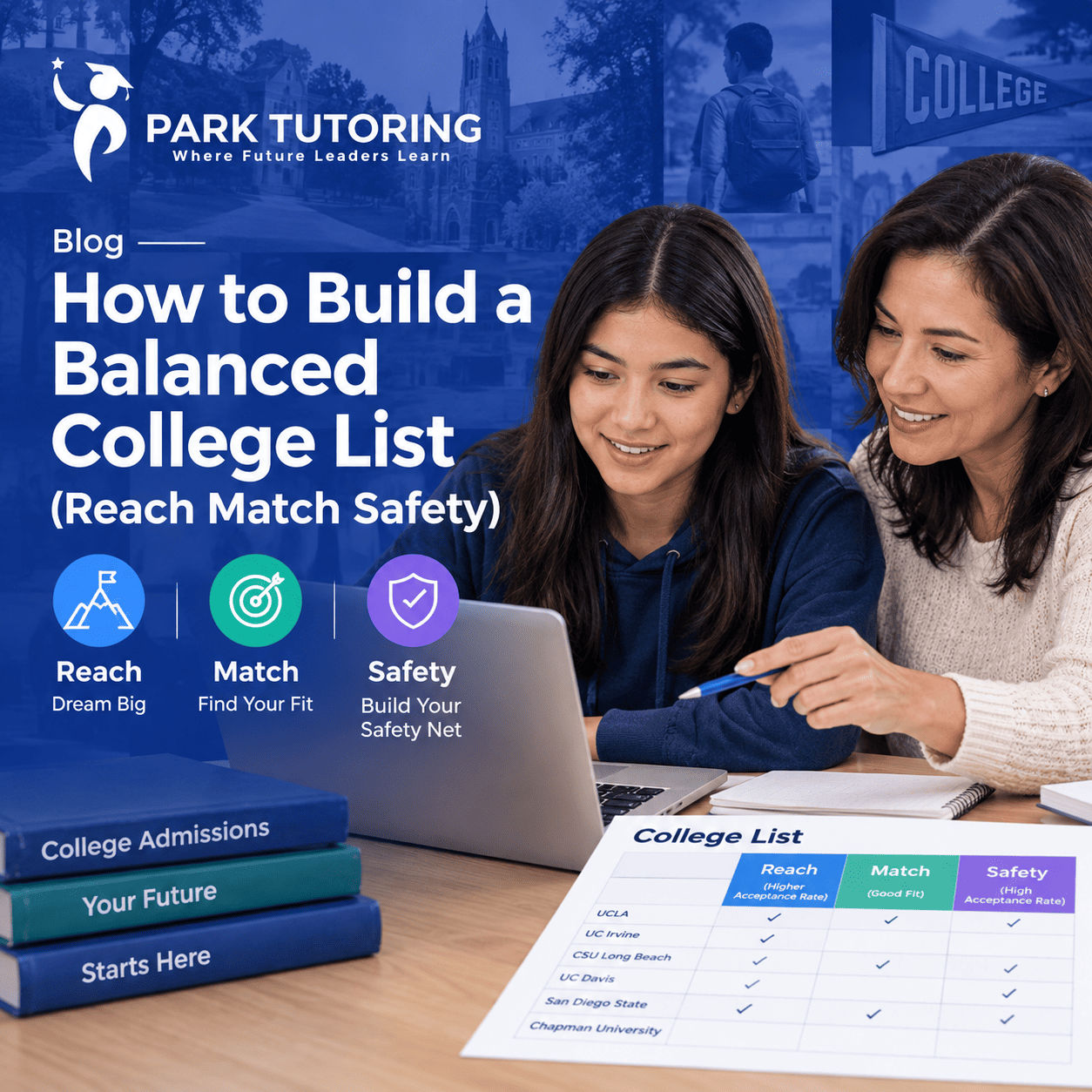
These three labels describe your statistical odds at a given school, based on how your GPA and test scores stack up against that school's recently admitted students. A reach is a school where your profile sits below the typical admitted range. A match puts you squarely inside it. A safety has you comfortably above it.
None of this is about how much you love a school. Plenty of students assume their dream school must be a match simply because they want it to be one. It doesn't work that way. These categories are statistical starting points, then get adjusted for context — holistic admissions policies, a hook like recruited-athlete status or legacy, or a major that's unusually competitive at that particular school.
Take a student with a 3.9 GPA and a 1450 SAT. Applying to a state flagship where admitted students typically land in the 1380-1480 range, that's a match. The same student applying to an Ivy, where admitted ranges skew higher and acceptance rates sit in single digits no matter your scores, is looking at a reach. Strong numbers don't change that. Holistic, low-acceptance-rate schools carry unpredictability for everyone who applies.
How many colleges should you apply to?
Somewhere between 8 and 12. Fewer than 8 often leaves too little cushion for the unpredictability baked into admissions, especially at competitive schools. More than 12 starts to dilute quality, because strong essays and thoughtful "why this school" answers take real time, per school, every time.
The right number shifts by situation:
- Highly competitive applicants targeting several low-acceptance-rate schools might lean toward 12-14, since reach outcomes are hard to predict no matter how you slice it.
- Students with a clear, affordable in-state option they actually like might get away with 6-8.
- Arts, film, or music applicants with portfolio or audition requirements often apply to fewer schools, since each one demands far more prep time than a standard application.
Here's a gut check I use with students: if you can't name one specific, genuine reason you're applying beyond ranking or reputation, cut it. Padding a list with schools you don't really want doesn't improve your odds. It just adds fees, essays, and stress you didn't need.
How do you figure out which tier a school belongs in?
Start with the numbers. Adjust for context after. Compare your unweighted and weighted GPA and test scores against a college's most recently published admitted-student data, which you'll find on the school's admissions site or through free tools like College Board's BigFuture, and Common Data Set reports many colleges post publicly.
Here's the general framework:
|
Tier |
Your GPA/scores vs. admitted range |
Typical acceptance rate context |
What it means
|
|---|---|---|---|
|
Reach |
Below the middle 50% range |
Often under 20%, or unpredictable even with strong stats |
Admission possible but not likely |
|
Match |
Within the middle 50% range |
Roughly 25-60% |
Admission reasonably likely, not guaranteed |
|
Safety |
Above the middle 50% range |
Often 60%+ |
Admission highly likely, and affordable |
Two adjustments matter beyond the raw numbers. Any school with an overall acceptance rate under roughly 15-20% functions as a reach for almost everyone, regardless of stats. So much of that decision comes down to essays, activities, and institutional priorities no student can fully predict. Second, check whether your intended major has separate admission data from the university overall. Computer science, nursing, and business are the usual offenders — impacted majors with their own, tighter admit rates.
How many schools should be in each tier?
A common split is 2-3 reach, 4-6 match, and 2-3 safety — though this shifts based on risk tolerance and total list size.
Students who feel good with a smaller list often go match- and safety-heavy: 1-2 reaches, 5-6 matches, 2-3 safeties. Students chasing highly selective outcomes might invert that slightly, but never drop below 2 safeties. A single safety is risky. Plans change — a late shift in application strategy, a surprise in financial aid needs — and one safety gives you no room to move.
Here's what it looks like in practice. An engineering-bound student might list MIT and Georgia Tech as reaches, Michigan and Purdue as matches, and their in-state public plus one smaller regional school as safeties. Every school on that list needs an engineering program the student actually wants — not a filler pick chosen just to hit a quota. I've seen students add a "safety" they'd never actually attend, just to check a box. Don't do that. It wastes an application slot and, worse, sometimes becomes the only acceptance in hand come April.
How do reach, match, and safety schools differ by grade level?
Your approach changes as you move through high school. The information available improves, and so does your sense of what you actually want.
9th and 10th grade
No list yet. But this is when the groundwork gets laid. Focus on course selection, grades, and exploring interests through clubs, summer programs, or early PSAT exposure. Casual campus visits during family trips help you start noticing what you respond to — big versus small, urban versus rural — with zero pressure to commit to anything.
11th grade
Real list-building starts here. By fall of junior year, take a PSAT or practice SAT/ACT to get a baseline score — that number anchors your reach/match/safety math. Spring of junior year is the window to research 15-20 schools broadly, visit a few if you can, and narrow toward a working list of 12-15 to refine over the summer.
Summer before senior year
Narrow to your final 8-12. Finish visits if possible. Draft your Common App personal statement (250-650 words) and take a first pass at supplemental essays for any early-deadline schools.
12th grade
Finalize applications by each deadline — Early Action and Early Decision typically land around November 1st, Regular Decision around January 1st-15th. Reassess the list one more time in early fall if senior-year grades or a new test score move your standing meaningfully.
What role does financial fit play in reach, match, and safety?
A school only counts as a true safety if your family can actually afford it. That means net price, not sticker price, after expected financial aid or scholarships. A school where you're guaranteed admission but priced out isn't a safety. It's just an expensive rejection you didn't need to apply for.
Use each college's net price calculator — usually on its financial aid page — to estimate what you'd actually pay based on family income and assets. Build this into the list early, not in spring of senior year when decisions are due and it's too late to pivot. I'd push most families to lock in at least one safety that's both a high-likelihood admit and a confirmed affordable option before a single financial aid package arrives. Often that's a well-regarded in-state public.
Merit aid complicates the framework in a useful way, honestly. Some schools that are admission "matches" for your academic profile also hand out strong merit scholarships to students near the top of their applicant pool. That can make a school a financial safety even when it's not a statistical one. Check each school's merit criteria — many list minimum GPA or test score thresholds for automatic awards, and it's worth knowing those numbers before you apply, not after.
What common mistakes should you avoid when building a college list?
- Treating "reach" as a synonym for "dream school." A school you love isn't automatically a reach or match. Its tier comes from your stats against admitted-student data, full stop.
- Applying to zero or one true safety. Without a confirmed likely admit that's also affordable, you risk ending up with no good options if reach and match outcomes go sideways.
- Ignoring cost until decisions arrive. Running net price calculators after acceptance, instead of before applying, is how families fall in love with a school they can't pay for.
- Copying a friend's list. A smart match for one student's profile can be a poor fit — academically, socially, financially — for another. Lists aren't transferable.
- Piling on reaches, skimping on matches. A list heavy on long shots feels exciting in October. It often produces a disappointing spring with almost no real choices.
- Skipping the "why this school" homework. Applying somewhere for the name alone, without checking major, size, or location fit, wastes a slot you could've used better.
|
Need a hand with college counseling? Park Tutoring's college counselors help students build a personalized reach-match-safety list using real admissions data, then guide them through essays and applications without ever writing the material for them. We coach students to make smart, well-researched decisions they can stand behind. → Book a free consultation at parktutoring.com |
How do you actually start building your list?
Get an honest read on your academic profile first, then research 15-20 schools broadly before narrowing anything down. Pull together your current GPA — weighted and unweighted — and your most recent PSAT, SAT, or ACT score. Compare those against published admitted-student ranges for a broad set of colleges that interest you based on location, size, major, and campus culture.
From that initial 15-20, sort each school into reach, match, or safety using the framework above, then check financial fit for anything you're seriously considering. Narrow the list over the summer before senior year. Cut anything you can't articulate a genuine reason for applying to, and make sure the final version has at least 2 safeties and no more than about 3 reaches. Finalize it — ideally 8-12 schools — before senior year deadlines start piling up each fall.
Frequently asked questions
How many reach schools should I apply to?
Most students apply to 2-3. Going beyond that adds workload without meaningfully improving your odds, since reach outcomes stay unpredictable no matter how many you stack on.
Is it bad to have too many safety schools?
Not harmful, just inefficient. If more than half your list is safeties, ask yourself whether you're playing it too safe and could add a match or two you'd genuinely enjoy.
Can a school be a match for one student and a reach for another?
Yes. Tier placement depends entirely on how your GPA and test scores compare to a school's admitted-student data. The same college can be a safety for one applicant and a reach for the next.
Should I include my in-state public university on my list?
For most students, yes. In-state publics tend to combine reasonable admission odds with strong affordability — a natural fit for the safety or match tier.
What if I don't know my test scores yet when I start my list?
Use your PSAT or early practice scores as a placeholder, then revisit tier placements once official SAT or ACT scores come in. Even one testing cycle can shift where a school lands.
Do acceptance rates alone tell me if a school is a reach?
No. Acceptance rate is one input among several. Your GPA and test scores relative to the admitted range matter just as much, and a competitive major can push a school's tier further out.