Share

Quick Answer
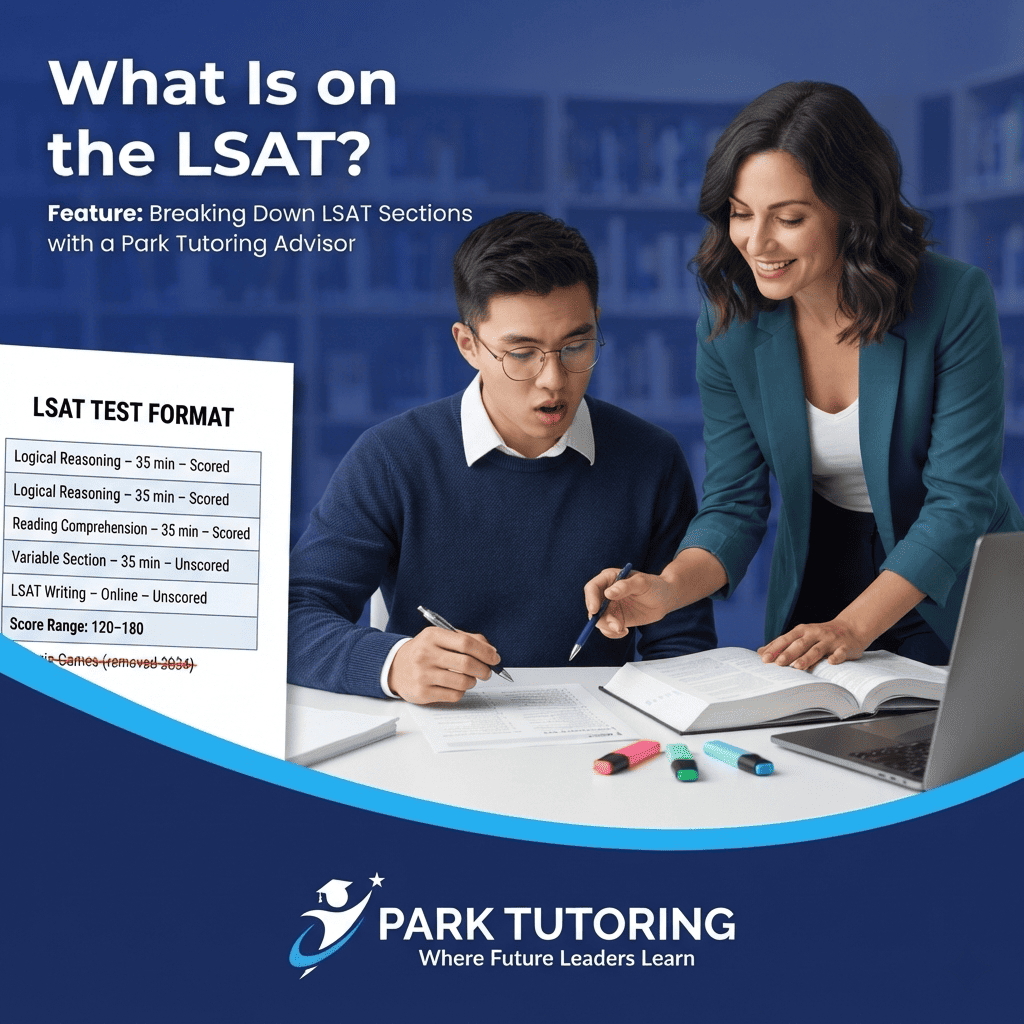
The LSAT includes two scored Logical Reasoning sections, one scored Reading Comprehension section, one unscored variable section used for test development, and a separate unscored LSAT Writing sample. As of August 2024, the Analytical Reasoning (Logic Games) section was permanently removed. Scores range from 120 to 180.
Key Takeaways
- The LSAT no longer includes Logic Games — that section was retired starting with the August 2024 test.
- The current scored format is two Logical Reasoning sections plus one Reading Comprehension section.
- An unscored "variable" section appears on every test but test-takers don't know which section it is.
- LSAT Writing is a separate, untimed-on-test-day essay you complete online and is not scored but is reviewed by law schools.
- Scores range from 120 to 180, with most competitive scores clustering in the upper third of that range.
- The test is almost entirely about reading and argument analysis, not memorized content, which changes how students should prepare.
A lot of our students come to us asking what is on the LSAT because whatever they heard from an older sibling or read on a forum five years ago doesn't match the test they're about to sit. That's fair — the LSAT changed in 2024. Here's what's actually on it now, how it's scored, and where to start.
What sections are on the LSAT?
The current LSAT has four sections on test day: two scored Logical Reasoning sections, one scored Reading Comprehension section, and one unscored variable section, plus a separate writing component you complete online, usually within a few days of your test date. Each section runs on its own clock, and you don't get to pick the order.
Logical Reasoning
This is the heart of the test, and it's not close. Each Logical Reasoning section hands you short arguments — a paragraph, sometimes two sentences — and asks you to find the assumption, spot the flaw, strengthen it, weaken it, or draw a conclusion that actually follows. Two scored sections of this means it's the single biggest chunk of your score, bigger than most students expect going in.
Reading Comprehension
Four passages. Law, science, humanities, social policy — the topics rotate, but the skill tested doesn't. Each passage comes with questions on structure, main idea, tone, and inference. One of the four sets is usually "comparative reading," two shorter passages on a related topic instead of one long one. Students who read a lot for pleasure sometimes assume this section is easy money. It isn't, and we'll get to why below.
The unscored variable section
Every test includes one extra section, dressed up like Logical Reasoning or Reading Comprehension, that doesn't count toward your score at all. LSAC uses it to field-test questions for future exams. You will not know which section this is while you're sitting there. None of them are labeled. So the only sane strategy is to treat every section like it's live, because for all you know, it is.
How long is the LSAT?
The LSAT runs roughly two and a half hours of actual testing time, split into four 35-minute sections with a short break in the middle. Here's the breakdown:
|
Section |
Format |
Time |
Scored?
|
|---|---|---|---|
|
Logical Reasoning (1) |
~25 arguments, multiple choice |
35 min |
Yes |
|
Logical Reasoning (2) |
~25 arguments, multiple choice |
35 min |
Yes |
|
Reading Comprehension |
4 passages, multiple choice |
35 min |
Yes |
|
Unscored variable section |
LR or RC format |
35 min |
No |
|
LSAT Writing |
One essay prompt |
Completed separately online |
No (unscored, but sent to schools) |
There's a break, usually about 10 minutes, after the second section. Parents sometimes picture a four- or five-hour marathon because of how admissions forums talk about "test day" in general terms. The actual in-seat, multiple-choice portion is closer to two and a half hours, break included. It feels longer. It is not longer.
Does the LSAT still include Logic Games?
No. Logic Games, officially Analytical Reasoning, was permanently removed starting with the August 2024 LSAT. This came out of a legal settlement over accessibility, since the diagramming-heavy format put test-takers with certain visual or processing differences at a real disadvantage.
If a prep book, a tutor, or a sibling's old binder is handing you Logic Games drills, close it. That section is gone. It was replaced with a second Logical Reasoning section, so LR skills now carry more weight than they used to — not less. We still see this trip up families who remember the LSAT from a decade ago and assume the format hasn't moved. It has. Before you commit to any course, book, or tutor, check that their materials actually reflect the current four-section, no-games format. This single question — does this reflect the post-2024 test — has saved more than one student from wasting a month of prep on a section that no longer exists.
What skills does the LSAT actually test?
The LSAT tests how well you read dense text, spot the logical structure of an argument, and hold up under a strict clock. That's it. No history, no science content, no vocabulary list, no math formulas waiting to trip you up.
In practice, the test rewards:
- Identifying unstated assumptions in an argument
- Telling a conclusion apart from the evidence propping it up
- Noticing when an argument's logic just doesn't follow from its premises
- Reading fast without going sloppy on detail-heavy passages
- Managing time across dense material with a clock running the whole way
This is a different kind of studying than most students have ever done. You can't cram vocabulary the night before or memorize a formula sheet. Progress comes from repeated, deliberate practice on real LSAT questions, paired with a review process that figures out why you missed something — not just that you did. Students who skip that second part plateau fast.
How is the LSAT scored?
The LSAT is scored on a 120 to 180 scale, based only on the two Logical Reasoning sections and the one Reading Comprehension section. The variable section and LSAT Writing never touch this number.
Your raw score — correct answers out of roughly 75 to 76 scored questions — gets converted to the 120–180 scale through a table that adjusts for small difficulty differences between test forms. That means missing six questions in June and missing six questions in October won't necessarily land you the same scaled score. Law schools do see your LSAT Writing sample next to your number, but it's read for writing ability, not folded into your score. And if you've taken the test more than once, schools generally see your full history, though most now lean on your highest score when they review an application.
Common mistakes students make when prepping for the LSAT
- Studying from outdated materials that still include Logic Games. Wasted hours on a section that doesn't exist anymore, while the two Logical Reasoning sections that now matter more get shortchanged.
- Treating it like a content test. Some students try to memorize "argument types" like vocabulary flashcards instead of actually practicing the reasoning underneath each question. That's a mistake we catch constantly in the first few sessions.
- Skipping timed practice until the final weeks. The pressure on this test comes from the clock as much as the content. Students who only practice untimed show up to the real thing without the stamina for it.
- Not reviewing wrong answers carefully enough. Marking a question wrong and moving on, without pinning down the exact reasoning error, throws away the most useful part of practice.
- Ignoring Reading Comprehension because it feels familiar. "It's just reading" is a trap. The density and pace under real conditions catch people off guard every time.
- Sitting the real test before a full-length practice test feels comfortable. A rushed date, forced by an application deadline, usually produces a worse score than waiting one more cycle would have.
How do I actually start preparing for the LSAT?
Start with one full, timed diagnostic test before you study anything else. No flashcards first, no section drills first — the diagnostic. It gives you and your tutor a real baseline instead of a guess, and it tells you right away whether Logical Reasoning or Reading Comprehension needs the heavier lift.
From there, a typical sequence runs: build core skills section by section (we usually start with Logical Reasoning, since it's two-thirds of your scored questions), layer in timed section practice once accuracy climbs, then shift to full timed practice tests about once a week as the real date approaches. Most students need three to six months of steady prep, though that range swings a lot depending on where they start, what score they're chasing, and how many hours a week they can actually give it. A student juggling a full course load and extracurriculars needs more runway than one prepping over a quiet summer. Start with the diagnostic, not a study plan pulled off the internet — prepping without knowing your actual weak spots just burns the early weeks.
|
Need a hand with LSAT prep? Park Tutoring works with students to build a personalized LSAT study plan based on a real diagnostic score, with ongoing coaching through Logical Reasoning, Reading Comprehension, and full timed practice tests. We coach the reasoning skills and review process, not shortcuts, so the progress actually sticks on test day. → Book a free consultation at parktutoring.com |
When should you take the LSAT, and how many times can you take it?
Most students take the LSAT in the spring or summer before the fall they plan to apply, which leaves room for a retake if the first score doesn't land where it needs to before deadlines close in. The test runs multiple times a year, and LSAC caps how many times you can sit for it within a testing year and over a lifetime — worth checking the current limits before you build a retake plan around assumptions.
A common mistake: treating the first test date as a throwaway "practice run" with a retake already penciled in. Retakes are allowed, sure, but law schools can see your full score history, and a string of low scores doesn't read the same way one strong score does. The better move is to treat your diagnostic and your practice tests as the low-stakes attempts, and walk into the official test date already at or near your target. If your real score comes in noticeably below your practice average, figure out what went wrong first — nerves, timing, an unfamiliar question type — before you just re-register and hope it goes better.
Subject Tutoring with Park Tutoring
Get 1-on-1 help from expert tutors with a plan built around your goals.