Share

Quick Answer
The Common App personal statement has a hard 250-650 word limit, and most students should write 600-650. Supplemental essays vary widely, from 50 to 400 words depending on the school. The real answer to how long a college application essay should be is whatever that application tells you, not a rule of thumb.
Key Takeaways
- The Common App personal statement tops out at 650 words, with a 250-word floor.
- Most strong personal statements run 600-650 words. They use the room they're given.
- Supplemental essays range from 50 to 400 words, and each college sets its own number.
- The Coalition Application and school-specific portals often use different caps than the Common App.
- Go over the stated limit and your essay gets cut off or flagged. Sometimes both.
- Coming in far under the limit almost always reads as thin, not efficient.
Every college application essay comes with a word limit, and that limit isn't a suggestion. It's a hard boundary set by the platform or the school itself. How long an essay should be depends entirely on which one you're writing — the Common App personal statement, a supplemental prompt, or a school's own short-answer question. Here's how each breaks down.
How long is the Common App personal statement?
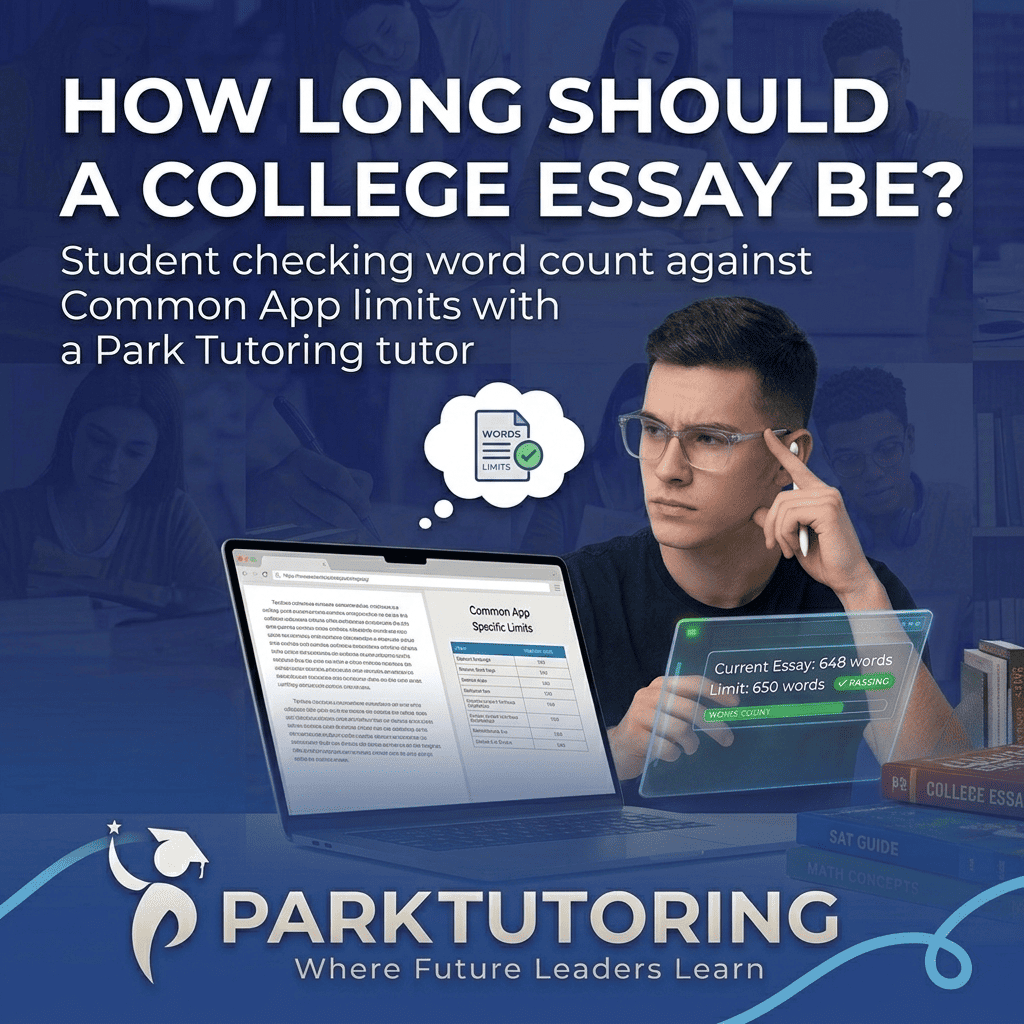
The Common App personal statement runs 250 to 650 words. The platform enforces this itself. Hit 650 and the text box stops taking input. No warning, no wiggle room.
Most admissions counselors, ours included, tell students to land between 600 and 650. A 350 or 400-word response technically clears the minimum, but it rarely leaves enough room to set a real scene, work through a reflection, and actually land on an insight about who you are. Colleges read thousands of these. A full-length essay tells them you took the assignment seriously and had something worth saying.
There's an exception, and it matters. If your story is genuinely tight — every sentence pulling weight at 500 words — padding it out to 650 does more harm than good. A sharp 550-word essay beats a bloated 650-word one, full stop. The goal has never been hitting a number. It's making every sentence necessary. But in fifteen-plus years of reading student drafts, we've found most kids who stop at 450 or 500 aren't showing restraint. They just haven't finished digging.
How long should supplemental essays be?
Supplemental length gets set school by school, and the range is wide. Some schools want a sentence — 25 to 50 words. Others want a full page, 500 to 650 words. Most sit somewhere between, in the 100-300 word zone.
Here's what that typically looks like across common prompt types:
|
Supplemental prompt type |
Typical word count
|
|---|---|
|
"Why this college?" |
100-250 words |
|
"Why this major?" |
150-250 words |
|
Short-answer/list questions |
25-50 words |
|
Community or identity essays |
250-400 words |
|
Extracurricular activity essay |
150 words |
|
Additional information / COVID impact |
Up to 250 words |
Since these limits shift school by school, and sometimes prompt by prompt within the same application, you can't work from memory or last year's template. A student we worked with last cycle tried recycling a 250-word "why us" essay for a school that capped the same prompt at 100 words. It didn't fit — not because the writing was bad, but because 150 of those words were doing nothing but taking up space once we trimmed. Check the current cycle's requirements in the portal every single time. Colleges adjust prompts and counts year to year, and treating two schools' versions of the "same" essay as interchangeable usually leaves you with something padded or half-finished.
Is it bad to go over the word limit?
Yes. This isn't a minor style issue — it's a real problem. On the Common App and most digital portals, the box physically refuses more input once you hit the cap, so submitting over-length isn't even possible there.
The real risk shows up on schools running their own systems or PDF-based supplements, where there's no hard stop built in. Some of those schools will just truncate your essay mid-sentence during review. Others read it as a sign you didn't follow directions — a small, avoidable red flag in a process that's competitive enough without adding self-inflicted ones. If a prompt says "150 words or fewer," that's a ceiling. Not a soft target you stretch to 180 because the point felt important.
The fix is always the same: trim, don't hope it slides. Look for redundant phrases, throat-clearing openers like "I have always believed that," and sentences repeating a point you already made better a paragraph earlier. Almost every draft we see can lose 10-15% of its length without losing a single real idea. Usually the essay gets stronger, not weaker.
Is it bad to go under the word limit?
Generally, yes. Using well under the space you're given usually signals the response isn't fully developed. If the Common App allows 650 words and a student turns in 300, admissions readers are left wondering whether there wasn't a complete story there, or the student just gave up early.
There's a difference between "under the limit" and "too short to work," though. A well-built 620-word personal statement is fine. A 350-word one usually isn't — there's not enough room for both a concrete scene and real reflection, and a strong personal essay needs both. As a rough guide, aim to use at least 90% of any word count above 200 words. That rule loosens for very short supplements, 50 words or under, since those prompts are testing precision on purpose, not asking you to fill space.
The one clear exception: prompts explicitly asking for something "brief" or "in a sentence or two." There, brevity is the actual skill being graded, and a long-winded answer works against you every time.
What are the length rules for different types of essays?
Different pieces of an application carry different length expectations. Worth knowing the categories before you start drafting anything.
The Common App personal statement
Your longest, most important essay: 250-650 words, sent to every school on your list. Because it's shared, it should stay personal — a story or trait about you, not anything tied to a specific school.
Coalition Application and university-specific essays
The Coalition Application caps its personal statement at 550 words, shorter than the Common App's 650. Schools running their own standalone applications — the UC system, for instance, with Personal Insight Questions capped at 350 words each — set entirely separate limits. Never assume Common App numbers carry over. They don't.
Supplemental "why us" and "why major" essays
These usually run 100-300 words. Admissions readers are checking for specificity here — how well you connect your actual interests to that school's programs, professors, or opportunities.
Short-answer and list-style prompts
Some schools (Stanford's list-style prompts are the classic example) ask for a handful of words per answer, sometimes just a phrase. These test economy of language. Not storytelling.
How do I know the exact word limit for a specific school?
The exact word limit sits right in the application portal, usually above or below the text box for that prompt. The Common App, Coalition App, and every individual school portal display their limits outright. You're never meant to guess.
Because these numbers are set by each school and change from cycle to cycle, the only source you should trust is the current application itself — not a blog post, not a forum thread, not what a former student remembers from two admissions cycles ago. Before drafting any supplement, open the actual prompt in the portal and write the limit at the top of your draft document. Small habit. Saves you from trimming a 400-word essay down to 250 after the fact, which is a miserable way to spend an evening.
One practical note: most portals show a live word count as you type. Draft somewhere else first — Google Docs, Word, whatever — then paste in once you're close to the limit. Portals time out and glitch more than you'd expect, and losing a finished draft to a refresh is not a lesson anyone needs to learn twice.
How should essay length change by grade level and application stage?
Length itself doesn't change by grade — the limits come from the application, not your age. What should change is how much time you budget at each stage.
- Junior year (spring): Start brainstorming personal statement topics before word count even matters. Write long and loose here, 1,000+ words if it comes naturally, then cut later.
- Summer before senior year: Draft the actual 650-word personal statement. No coursework competing for attention, so use it.
- Early fall of senior year: Move to supplemental essays, adapting a general "why this school" draft down to each college's specific cap.
- Regular decision season (December-January): Go back and re-trim earlier drafts. Word limits get overlooked constantly in the rush of early applications, and it's worth a second pass.
What are common mistakes students make with essay length?
- Writing far under the limit and calling it "concise." A 300-word personal statement usually isn't tight writing. It's an unfinished one. Use the space you've been given to build a real scene and think it through.
- Padding to hit a number. Filler phrases and repeated ideas dressed up in new words don't make an essay feel substantial — they make it feel bloated. Every sentence should be doing something.
- Reusing one essay across schools with different limits. A "why us" essay built for 250 words won't slide cleanly into a 100-word slot somewhere else. That takes real editing, not just deleting the back half.
- Ignoring the portal's live word counter. Some students draft entirely in Word, paste into the application, and only find out they're 40 words over when submission fails.
- Treating short-answer prompts like mini-essays. A 50-word response doesn't want an introduction and a conclusion. It wants one sharp point.
- Waiting until the deadline to trim. Cutting a strong essay down late usually exposes a structural problem — a slow opening, a redundant paragraph — that needs more than one editing pass to actually fix.
|
Need a hand with college counseling? Park Tutoring's college counselors help students figure out how much space they actually need to tell their story, then coach them through drafting and trimming essays to fit every school's specific limit. We guide the revision process — asking questions, flagging what's missing or excessive — while students do the writing themselves. → Book a free consultation at parktutoring.com |
How do I actually start drafting when I don't know what to write yet?
Start without a word limit in your head at all. Free-write about one specific moment, challenge, or detail from your life for 20-30 minutes. Chase volume, not polish. A thousand words of raw, messy material is much easier to shape than a blank page staring back at you.
Once there's a rough draft, find the single moment or idea that feels most alive on the page. Build the real essay around that one thread instead of trying to cover everything that happened that year. From there, trim in passes: cut what doesn't serve the central idea first, tighten individual sentences second, then read the whole thing out loud to catch the clunky parts your eyes skip over. Working long-to-short is almost always easier than trying to stretch a thin idea to fill 650 words from a standing start. We've watched students try the second approach. It shows.
Subject Tutoring with Park Tutoring
Get 1-on-1 help from expert tutors with a plan built around your goals.
Frequently Asked Questions
Details
Date
Oct 07, 2026
Author
Park Tutoring
Category
None
Reading
9 Min