
Share

|
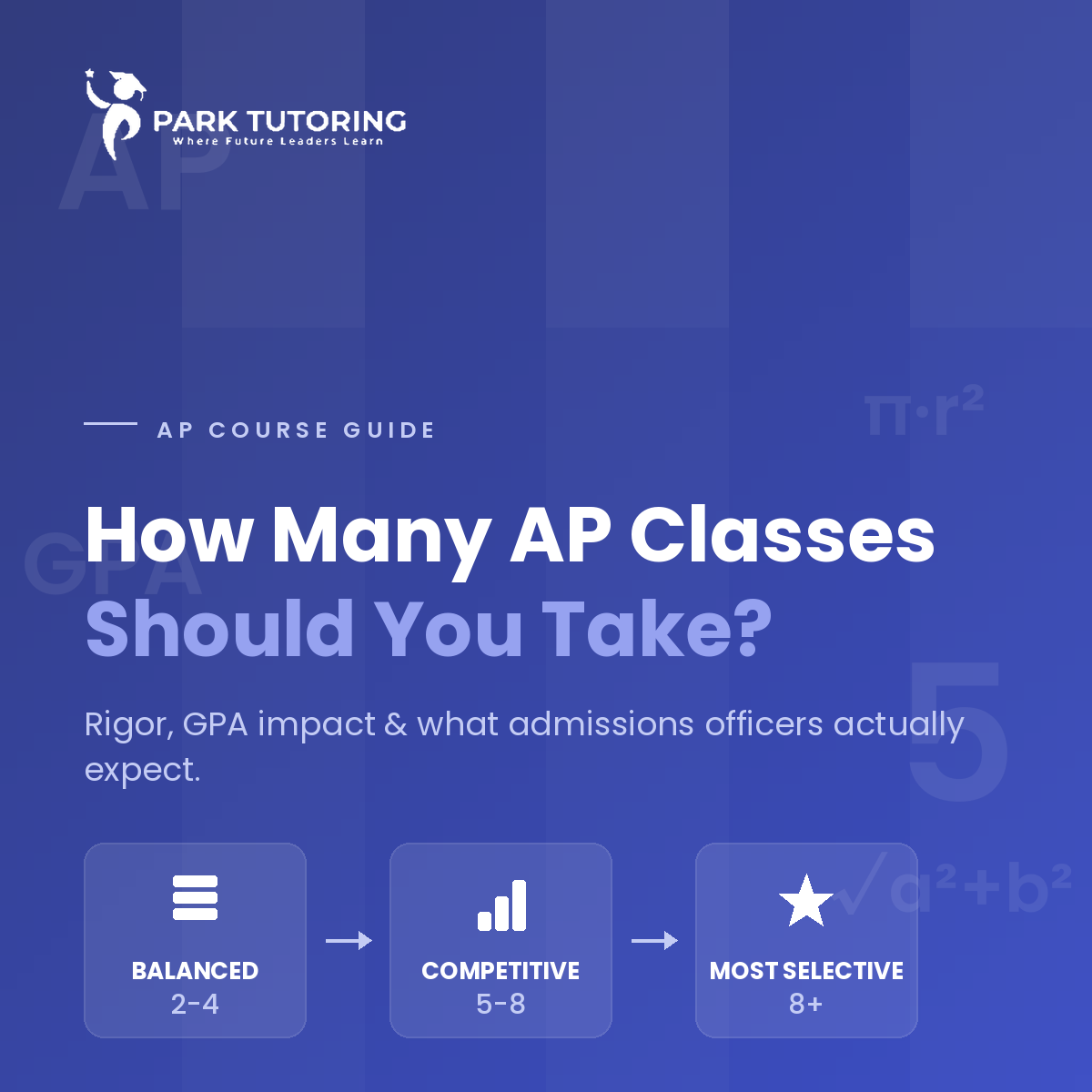
QUICK ANSWER Most students land somewhere between 3 and 6 AP classes total across high school, in subjects they're genuinely strong in or curious about. Highly selective colleges typically admit students with 7-12 APs by senior year, but rigor matters more than raw count. A padded transcript full of B's loses to a focused one full of A's, every time. |
|
KEY TAKEAWAYS
|
An AP course load is one of the most confusing parts of building a high school transcript. Take too few, and you look like you didn't push yourself. Take too many, and you risk a transcript full of B's and a burned-out junior year. Here's how to actually think about the right number for your situation.
How many AP classes should I take overall?
Most students do best taking somewhere between 3 and 6 AP classes across all four years, though this swings hard depending on your school, your workload tolerance, and your college goals. There's no magic number admissions officers are hunting for. They evaluate your course load against what your own high school offers, not against some national average.
A student at a school offering only 6 AP courses total isn't expected to keep pace with a student whose school offers 30. What matters is whether you pushed yourself within your school's own context. Skip all 10+ APs your school offers, and that raises eyebrows. Take 4 out of 5 available, and that reads as serious rigor.
Treat your AP count as one input, not the headline of your application. Admissions readers weigh it alongside your GPA trend, extracurricular depth, essays, and recommendations. A student with 4 APs, all A's, strong extracurriculars, and a sharp essay often beats a student with 9 APs and a transcript full of B-minuses. That's just how it plays out. Start by asking what you can handle well. Not what number sounds impressive on paper.
What's a reasonable AP course load by grade level?
Your AP load should build gradually — light in 9th grade, peaking in 11th, tapering a bit in 12th as college applications eat into your time. Ramping up too fast, too early, is one of the most common mistakes we see, and one of the most avoidable.
9th grade
Most freshmen should take zero or one AP class, if any. Plenty of schools don't even offer APs to freshmen, and that's on purpose. 9th grade is when you're still figuring out how to manage a demanding course load, and these grades still count toward your cumulative GPA.
10th grade
Sophomore year is a reasonable time to add one or two APs, ideally in a subject where you've already shown strength, like AP World History or AP Biology. Think of it as a testing ground before junior year's heavier load hits.
11th grade
Junior year is typically the peak AP year, since these are the grades and scores colleges see before you apply. Two to four APs is common, though this depends heavily on your school's scheduling and your own bandwidth.
12th grade
Senior year usually matches or slightly dips from junior year. Colleges will see your senior schedule on the application even before final grades roll in, so dropping APs entirely can look like coasting. But you don't need to max out your schedule while you're drafting essays and finishing applications.
How many AP classes should I take for Ivy League admission?
Admitted students at Ivy League and similarly selective schools commonly show 7 to 12 AP classes by graduation. That's a pattern among admits, not a requirement, and selective admissions offices say outright that they evaluate rigor in context, not against a fixed target.
This matters because families sometimes chase a number they read online without checking whether their school even offers that many APs, or whether their kid has the bandwidth for it. A student who takes 12 APs and lands a mix of B's and C's isn't more competitive than one who takes 7 and earns A's, paired with a real extracurricular achievement and an essay that actually sounds like them.
What selective colleges look for is the "most rigorous course load available" language you'll see on school profile reports. If your school caps APs at 6, taking all 6 with strong grades shows the same commitment as a student elsewhere taking 10. If you're aiming Ivy-level, focus on three things: APs tied to your intended major or clear strengths, mostly A's in those classes, and exam scores of 4 or 5 where you actually sit for the test. A packed schedule with mediocre results works against you harder than a focused, excellent one works for you.
How does AP course load affect GPA and college applications?
AP classes usually carry weighted GPA value, often a full point above an unweighted A, which means a strong AP load can meaningfully lift your weighted GPA. But only if your grades hold up. A C in an AP class drags down your unweighted GPA and cancels out the rigor benefit you were chasing.
Colleges often recalculate GPA using their own methodology, and some ignore weighting entirely, looking instead at unweighted grades alongside a separate rigor assessment. So the "boost" you see on your high school transcript isn't guaranteed to carry the same weight in an admissions office.
In practice, two students with similar weighted GPAs can look very different to a reader. A student with 5 APs and all A's tells a cleaner academic story than one with 9 APs and a mix of A's, B's, and a C, even if their numbers land close together on paper. If you're choosing between squeezing in an extra AP and protecting your GPA, protect the GPA. That's usually the safer move, especially in a subject outside your intended major.
Which AP classes should I choose, and does subject matter?
Choosing APs that align with your intended major or a genuine interest matters more than the total count. Admissions officers look for a coherent academic story. A scattershot mix of unrelated APs can read as box-checking instead of real curiosity.
- STEM-intending students benefit from AP Calculus (AB or BC), AP Biology, AP Chemistry, or AP Physics, depending on the specific interest.
- Humanities-intending students benefit from AP English Language/Literature, AP US History, AP European History, or AP Government.
- Business or economics-intending students benefit from AP Micro/Macroeconomics, AP Statistics, and AP Calculus.
- Undecided students should prioritize the APs they're strongest in and genuinely enjoy. Consistency and performance matter more than a themed list this early.
Worth naming as an edge case: some students take an AP outside their intended field just to show range, like a STEM kid taking AP Art History or AP Psychology. Fine in moderation. But it shouldn't replace depth in your core area.
How do I decide if I'm ready for a specific AP class?
Check your grade trend in the prerequisite or related regular course, and talk to your current teacher before you enroll. A student pulling B's in regular chemistry is unlikely to thrive right away in AP Chemistry without a real support plan in place.
Most high schools have informal or formal prerequisites, and teachers are usually straight with you if you ask directly. Beyond grades, look at your schedule. Are you already committed to a demanding extracurricular, a part-time job, or another AP that hits during a heavy homework stretch? Stacking two reading- and writing-heavy AP humanities courses in the same semester, for instance, often creates more strain than pairing one humanities AP with one quantitative AP.
What are common mistakes students make with AP course loads?
- Overloading junior year all at once. Jumping from zero APs to five in a single year usually backfires. You haven't built the study habits or time-management skills those classes demand.
- Choosing APs for how they look rather than genuine interest or strength. A transcript padded with mismatched APs in a subject you dislike tends to produce weaker grades and a less coherent story.
- Ignoring the exam itself. Some students treat the class grade as the finish line and cram for the May exam at the last minute, leaving college credit or placement on the table.
- Not checking college credit policies in advance. Every college sets its own AP credit rules, and some now accept fewer credits than they used to. That class you assumed would save you money in college might not.
- Skipping conversations with your counselor. Counselors know your school's rigor context and can flag whether your planned load looks unusually light or heavy for what selective colleges from your school typically expect.
- Sacrificing extracurriculars entirely for AP count. Admissions officers value depth in activities alongside rigor, and a schedule with zero time for anything but AP homework can actually weaken an application.
|
Need a hand with AP prep? Park Tutoring helps students map out an AP course load that fits their goals, school, and schedule, then supports them with subject tutoring and exam prep throughout the year. We coach students to build the study habits and content mastery that make a heavier course load sustainable, rather than doing the work for them. → Book a free consultation at parktutoring.com |
How do I actually build my AP course plan?
Start by pulling your school's official AP offerings and any prerequisites, then map out a four-year plan with your counselor before locking in this year's schedule. That turns an abstract decision into something concrete you can actually adjust.
Here's a sequence that works for most families:
- List every AP your school offers, along with prerequisites and typical grade-level eligibility.
- Identify 2-3 subject areas connected to your academic strengths or intended major.
- Sketch a rough four-year timeline, front-loading fewer APs in 9th and 10th grade and more in 11th.
- Talk to current teachers in subjects you're considering. They know your work habits firsthand.
- Review the plan with your school counselor, who can flag scheduling conflicts or rigor concerns specific to your school.
- Reassess every semester. Grades, interests, and energy levels change. It's normal to add or drop a planned AP as you go.
|
Grade |
Typical AP Load |
Focus
|
|---|---|---|
|
9th |
0-1 |
Build study habits, explore interests |
|
10th |
1-2 |
Add APs in areas of strength |
|
11th |
2-4 |
Peak rigor year; align with intended major |
|
12th |
1-3 |
Maintain rigor while managing applications |
Frequently asked questions
How many AP classes should a sophomore take?
Most sophomores should take one or two AP classes, typically in a subject where they've already shown strength, like AP World History or AP Biology, while continuing to build study skills for heavier junior-year loads.
Do colleges prefer fewer APs with A's or more APs with B's?
Most selective colleges prefer strong grades in a rigorous but manageable course load over a maxed-out AP count with inconsistent grades. GPA trend and performance often carry more weight than raw AP totals.
How many AP classes should I take if my school offers very few?
Take the most rigorous options your school offers, and supplement with honors classes or documented independent study if you want additional challenge. Admissions officers evaluate rigor relative to your school's actual offerings, not a national list.
Can I self-study for an AP exam without taking the class?
Yes, plenty of students self-study for AP exams in subjects their school doesn't offer. It takes real independent discipline, though, and it doesn't show up as course rigor on your transcript the way an actual AP class does.
Does the number of AP classes affect college scholarship eligibility?
Some merit scholarship programs factor in course rigor, AP load included, as part of a broader academic profile. But criteria vary a lot by school and program, so check the specific requirements instead of assuming a set number is required.
What happens if I take an AP class and get a low exam score?
A low AP exam score generally doesn't hurt your application, since most colleges only see your course grade on the transcript unless you choose to self-report exam scores. And self-reporting a low score is usually optional anyway.
|
ABOUT THE AUTHOR The Park Tutoring Team is an Irvine, California-based tutoring and college-prep company specializing in AP prep, SAT/ACT test preparation, and college counseling. We help students build course plans and study strategies that balance academic rigor with real, sustainable success. |
.jpg)