Share

Quick Answer
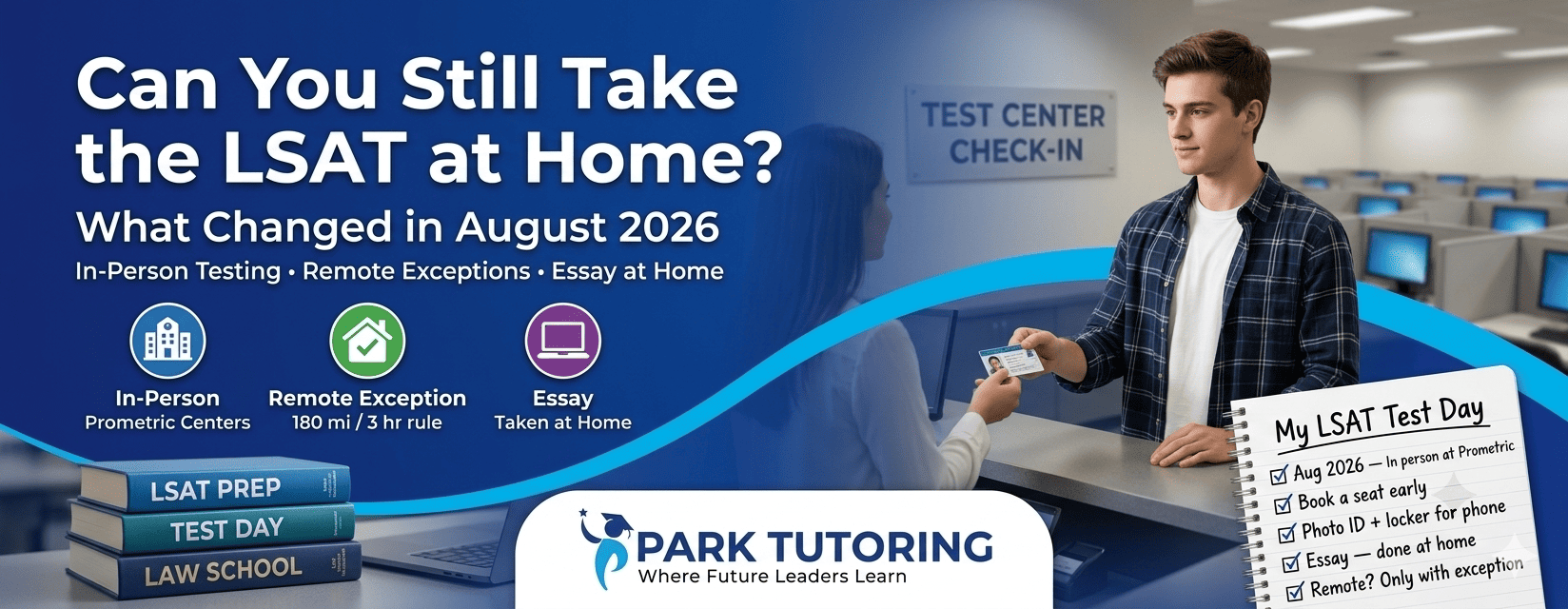
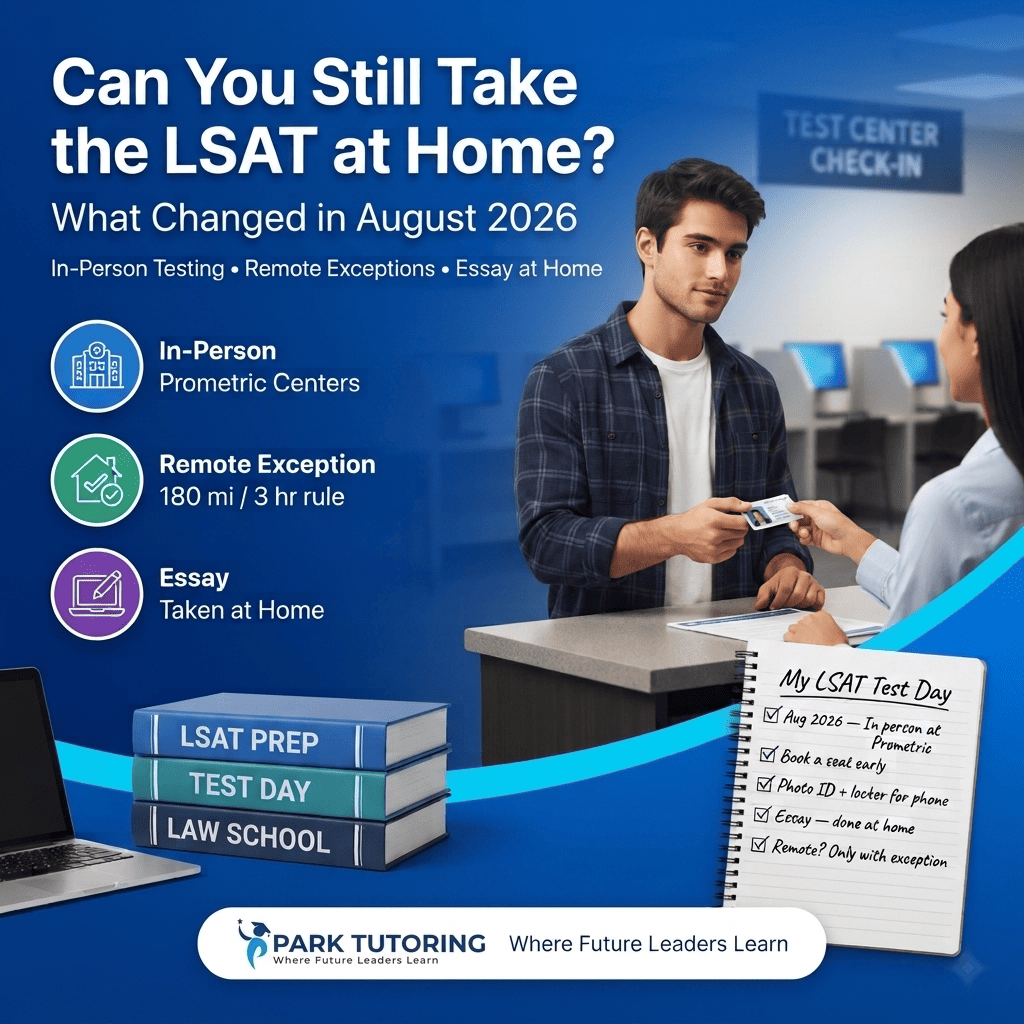
For most test takers, no. Since the August 2026 administration, LSAC gives the multiple-choice LSAT in person at Prometric test centers. At-home testing is limited to Remote Testing Exceptions for candidates more than 180 miles or three hours’ drive from a center with open seats, or with a documented disability. The essay is still taken at home.
Key Takeaways
- In-person testing is the new default. It started with the August 2026 LSAT.
- Remote testing is an exception, not a choice. Convenience doesn't qualify.
- The distance rule is 180 miles or three hours. It's measured from a center with open seats.
- Disability-related requests go through accommodations. They follow the accommodation deadline.
- Remote testers need a second camera. A smartphone is required from August 2026.
- The essay is still at home. LSAT Argumentative Writing hasn't moved.
For six years, many students took the LSAT from a bedroom desk. So when LSAC announced in February 2026 that the test was moving back to centers, we heard a lot of worried questions — especially from students far from big cities. This guide covers what changed, who can still test at home, how to request an exception, and how to plan for test day.
Can you still take the LSAT at home?
For most people, no. Since August 2026, the multiple-choice LSAT has been given in person at Prometric test centers. At-home testing is only available through a short list of Remote Testing Exceptions that LSAC approves case by case.
That's a big change from 2020 through mid-2026, when remote testing went from an emergency measure to an everyday option. Many students built their whole prep routine around a home setup, and that routine doesn't carry over to a center on its own.
In practice: assume you're testing in person unless you have a documented reason you can't. Look up your nearest Prometric centers before you pick a test date. If the closest center with open seats is far away, check the distance exception right then — not during test week.
Why did LSAC move the LSAT back to test centers?
LSAC moved the LSAT back to centers to strengthen test security and protect what a score means. Remote proctoring solved a real problem during the pandemic, but a high-stakes exam taken in thousands of private rooms is much harder to protect.
LSAC has noted that services offering unauthorized help target nearly every standardized test, and remote setups give them more openings. That affects honest test takers too. If law schools start doubting whether scores reflect each person's own work, every score loses some of its value.
To soften the change, LSAC said it was adding test centers and testing appointments for each administration. The goal is to keep a seat within reasonable reach for as many candidates as possible, especially students who live outside major cities.
When did the switch to in-person testing happen?
LSAC announced the change in February 2026, and it took effect with the August 2026 LSAT, the first test of the 2026–2027 testing year. June 2026 was the last administration where at-home testing was broadly available.
Remote testing began in 2020 as a pandemic response. From August 2023 through June 2026, test takers could choose between home and a center. Starting in August 2026, everyone tests in person unless LSAC approves an exception.
If you took an official LSAT at home before August 2026, that score is still valid and reportable. What changes is how you'll test from here on. If you're planning a retake, expect a center, a check-in process, and a shared room — and prep for that setting.
How do you request a remote testing exception?
You request a remote testing exception through your LSAC JD Services account after registering for a specific LSAT. For the distance exception, use the LSAT Status page and upload proof of the address where you'll test, such as a driver's license or utility bill. Disability-related requests go through the accommodations process instead.
LSAC reviews distance requests first come, first served, and it won't accept them after the stated deadline. Its decisions are final. If you're approved, you're limited to remote testing for that administration and can't switch back to a center for the same date.
We've seen students discover a week before the test that the nearest center was full, only to find the request window already closed. Check center availability the day you register, and file any exception right away.
Who qualifies for a Remote Testing Exception?
LSAC limits remote testing to situations where testing at a center would be genuinely unreasonable, not just inconvenient.
The distance exception
This covers test takers in the U.S., U.S. territories, and Canada who are more than 180 miles or three hours' drive from a center with available seats. A closer center that's fully booked doesn't count against you, so check open seats, not just locations.
The disability-related exception
Candidates whose disability or medical condition makes center testing unworkable can request remote testing through accommodations. It's treated as an exceptional-needs request, so it needs thorough documentation.
Military service and center closures
Active-duty service members who meet LSAC's military policy can request an exception by email before the registration deadline. If weather or another emergency closes your scheduled center, LSAC contacts you with options.
What do you need if you're approved to test remotely?
Approved remote testers need a compatible computer, a stable internet connection, a private room, a valid photo ID, and a smartphone set up as a second camera. The second camera is required for every remote test taker starting with the August 2026 LSAT.
The extra camera gives proctors a fuller view of your space, and it's part of the same security push behind the move to centers. Decide where your phone will sit before test day, and keep it charged.
Run LSAC's system check at least a week early. Test your webcam and microphone, clear your desk, and pick a room with a door. With only eight LSAT dates a year, losing one to a tech problem is costly.
Is LSAT Argumentative Writing still taken at home?
Yes. Every test taker completes LSAT Argumentative Writing online on their own computer, including people who take the multiple-choice test at a center. This is the part of the 2026 change that confuses students most.
The essay opens eight days before your test and is remote-proctored through your webcam, microphone, and screen. It isn't scored, but it's required. LSAC won't release your score until a writing sample is on file, and schools receive a copy.
So even if you test in person, plan for about 50 quiet minutes at home. We recommend finishing the essay during the eight-day window before your test, so it can't delay your score.
Common mistakes students make about testing at home
- Assuming at-home testing is still the default. It hasn't been since August 2026, so plan for a center.
- Requesting remote testing for convenience. A preferred date or a long commute doesn't qualify.
- Measuring distance to the wrong center. The rule is based on centers with open seats, not the nearest address.
- Missing the request window. Late requests aren't accepted, and decisions are final.
- Forgetting the essay is still at home. Skip it, and your score stays on hold.
|
NEED A HAND WITH LSAT PREP? Park Tutoring helps students prepare for in-center testing, from timed full-length practice in realistic conditions to a test-day plan for travel, check-in, and the essay. We coach strategy and pacing so the switch from home testing doesn't cost points. → Book a free consultation at parktutoring.com |
How does in-person testing change your test-day planning?
Because the LSAT is now in person for nearly everyone, your test date comes with new logistics: booking a seat, getting to the center, and checking in. None of it is hard, but it rewards planning ahead.
|
Your situation |
What to expect |
What to do |
|---|---|---|
|
A center within easy driving distance |
Check-in, ID check, and a locker for your phone |
Book early and do a dry-run drive |
|
Nearest open center is a long drive, under 180 miles |
A long trip before a demanding exam |
Stay near the center the night before |
|
No open center within 180 miles or three hours |
Likely eligible for a distance exception |
Request it in JD Services right after registering |
|
A disability that makes center testing unworkable |
Remote testing considered through accommodations |
Submit an accommodations request by the deadline |
The takeaway we give every student: plan your test location as carefully as your test date. Look up centers before you register, practice full-length tests with scratch paper and some background noise, and treat the center as part of test day.
Subject Tutoring with Park Tutoring
Get 1-on-1 help from expert tutors with a plan built around your goals.