

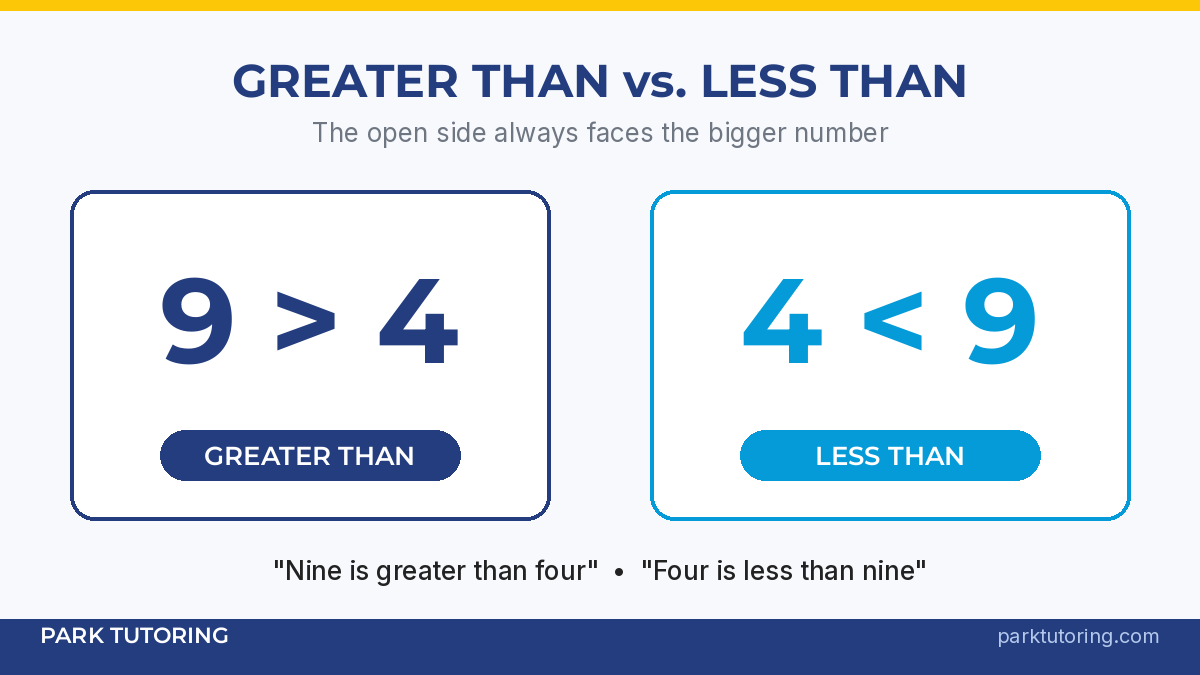
Quick answer: the open side of the symbol always faces the bigger number, and the pointed side always faces the smaller one. So 9 > 4 means “9 is greater than 4,” and 4 < 9 means “4 is less than 9.” If you can remember that the symbol “opens toward” the larger value, you can figure out every inequality sign from scratch — no memorization required.
Every math tutor has watched a student breeze through a hard problem, then lose the point because they wrote < when they meant >. It happens to second graders learning to compare numbers, and it happens to juniors on the SAT solving inequalities under time pressure. The two symbols are mirror images of each other, so mixing them up is one of the most common small mistakes in all of math.
The good news: this is a five-minute fix. Below you'll find a chart of all five inequality symbols, three memory tricks (pick whichever one sticks), and the one rule about flipping the sign that trips up algebra students every year.
What Do the Greater Than and Less Than Signs Mean?
The greater than sign ( > ) and the less than sign ( < ) are comparison symbols. Instead of solving for an answer, they describe the relationship between two values — which one is bigger and which one is smaller. Math problems that use them are called inequalities, because the two sides are not equal.
You always read an inequality from left to right, starting with the value on the left:
- 9 > 4 reads as “nine is greater than four”
- 4 < 9 reads as “four is less than nine”
Notice both statements describe the same fact — they just start from a different side. That's why the direction of the symbol matters so much.
All 5 Inequality Symbols at a Glance
|
Symbol |
Name |
What it tells you |
Example |
|
> |
Greater than |
The left side is bigger |
9 > 4 (9 is greater than 4) |
|
< |
Less than |
The left side is smaller |
4 < 9 (4 is less than 9) |
|
≥ |
Greater than or equal to |
The left side is bigger, or the two sides match |
x ≥ 5 (x is 5 or anything above it) |
|
≤ |
Less than or equal to |
The left side is smaller, or the two sides match |
x ≤ 5 (x is 5 or anything below it) |
|
≠ |
Not equal to |
The two sides are different |
7 ≠ 2 (7 does not equal 2) |
Trick 1: The Alligator Method
This is the classic, and it works because it turns an abstract symbol into a picture. Imagine the symbol is a hungry alligator's open mouth, and the numbers on either side are its food. The alligator is greedy — it always chomps toward the bigger meal.
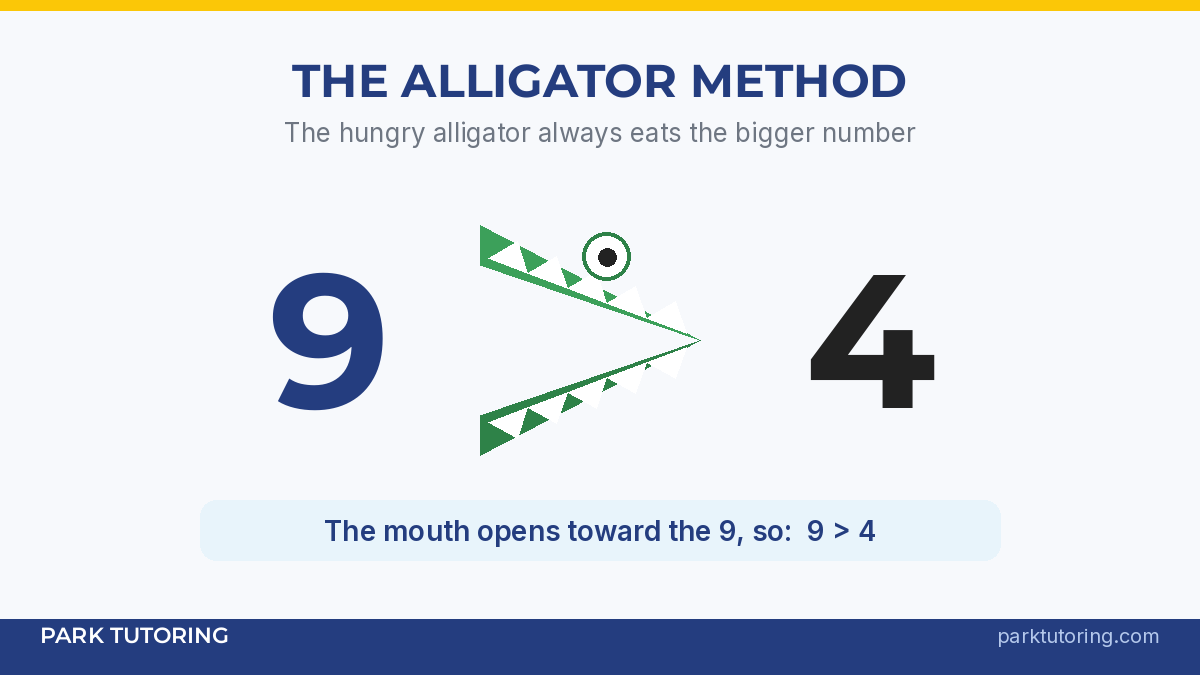
Look at 9 > 4. The mouth opens toward the 9, so 9 is the bigger number. In 4 < 9, the mouth swings around to face the 9 again — the alligator doesn't care which side the big number is on, it just wants to eat it. Some of our younger students draw a little eye and teeth on the symbol while they're learning. Whatever it takes.
One thing we add when we teach this at Park Tutoring: don't stop at “the alligator eats the big number.” Say the full sentence out loud — “nine is greater than four.” The trick tells you which way to draw the symbol; reading it aloud is what builds the actual understanding you'll need for algebra later.
Trick 2: The L Method
“Less than” starts with the letter L. Tilt the less than sign ( < ) slightly and it looks like a sloppy capital L. The greater than sign ( > ) doesn't look anything like an L, so it can never mean “less than.”
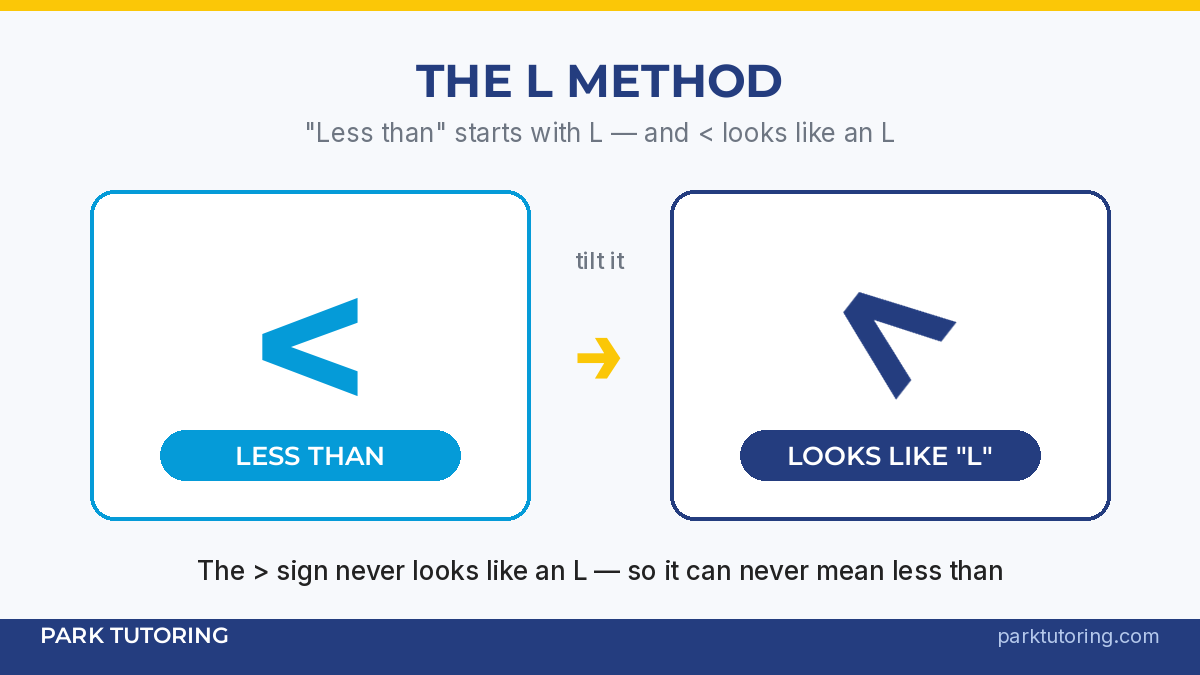
That's the whole trick. It's faster than the alligator once you're past elementary school, and it works quietly in your head during a timed test. You can also make an L with your left thumb and index finger — your left hand makes the “less than” shape.
Trick 3: Big Side, Small Side
If you'd rather understand the symbol than memorize a story about it, look at its shape. Each symbol has a wide, open side and a narrow, pointed side. The wide side sits next to the bigger value. The point aims at the smaller value — like an arrow pointing at the little number.
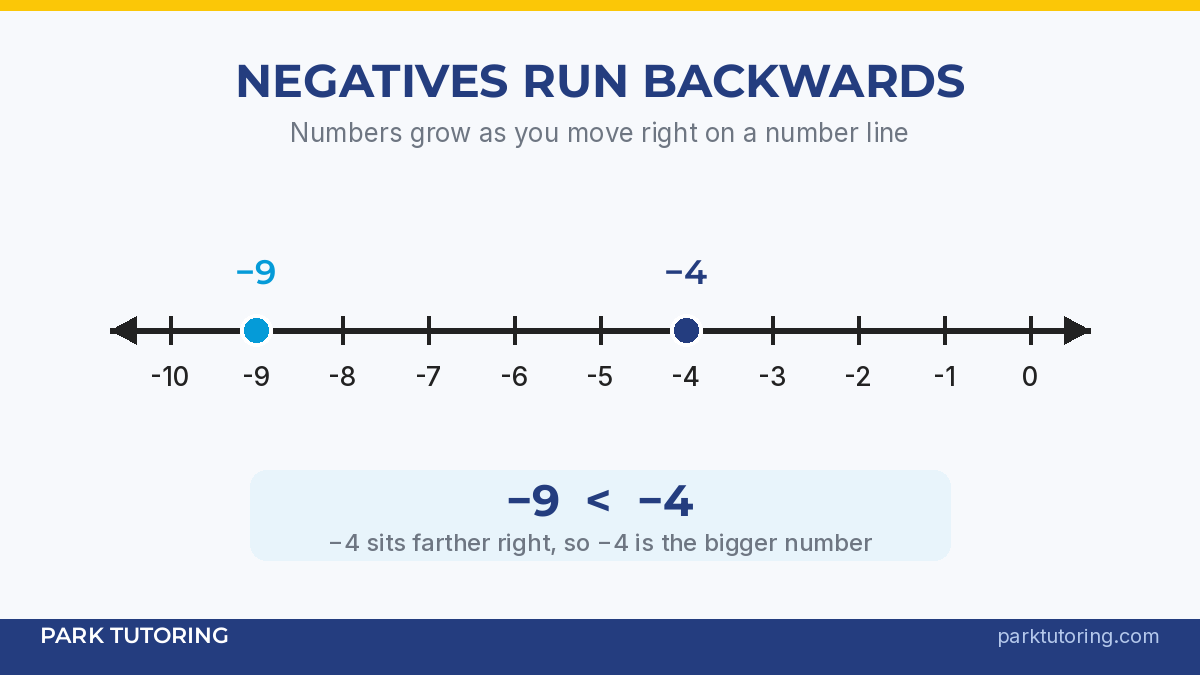
This is the same logic a number line uses. Numbers grow as you move right, and the symbol's opening tracks the growth. Once students see this, they stop needing tricks at all: the symbol simply shows which side is big and which side is small.
What About ≥, ≤, and ≠?
Once you know > and <, the other three symbols come free.
- ≥ means greater than or equal to. It's just a greater than sign with half an equal sign tucked underneath. x ≥ 5 means x can be 5, or anything bigger.
- ≤ means less than or equal to. Same idea: a less than sign over half an equal sign. x ≤ 5 means x can be 5, or anything smaller.
- ≠ means not equal to — an equal sign with a line through it. 7 ≠ 2 simply says the two values are different.
Watch for the wording in word problems. “At least 16” means ≥ 16. “No more than 100” means ≤ 100. “More than 100” — without the “no” — means > 100, strictly. The difference between “at least” and “more than” is exactly one point on a test.
When Do You Flip the Inequality Sign?
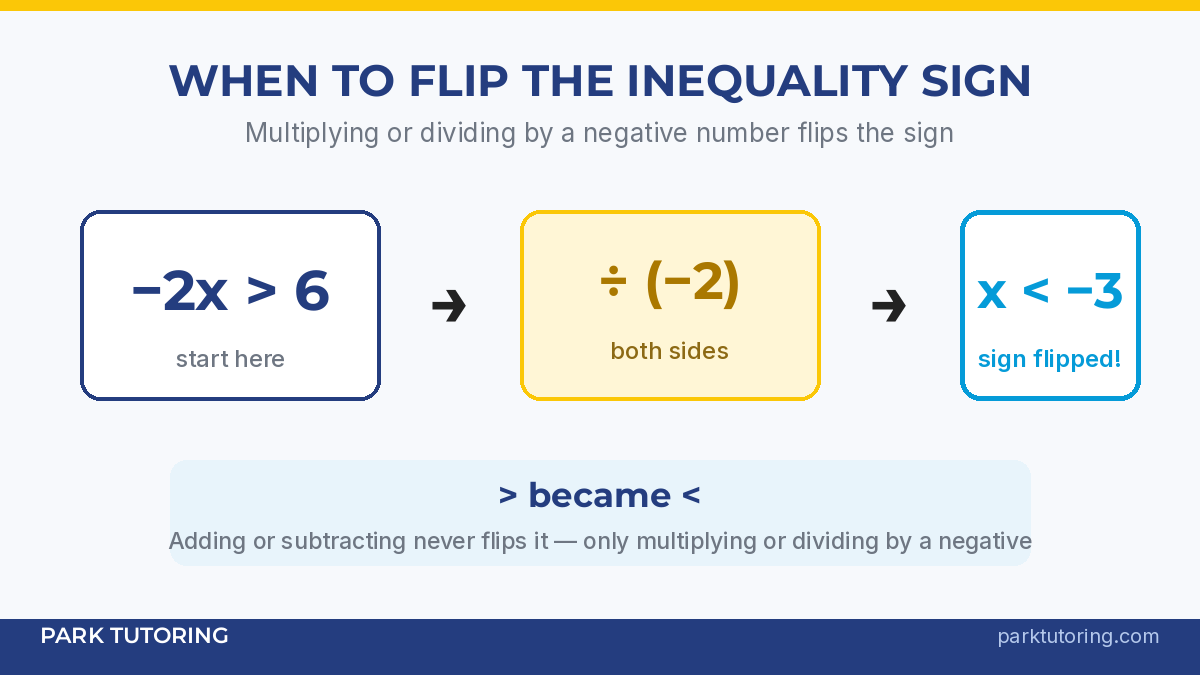
Here's the rule that matters once you hit algebra, and the one students forget most: whenever you multiply or divide both sides of an inequality by a negative number, the sign flips direction.
Say you're solving −2x > 6. Divide both sides by −2 and the > flips to <, giving you x < −3. Why? Multiplying by a negative reverses the order of numbers — 3 is greater than 2, but −3 is less than −2. The flip keeps the statement true.
Two quick guardrails we drill with our algebra and SAT students:
- Adding or subtracting never flips the sign — only multiplying or dividing by a negative does.
- Never multiply or divide an inequality by a variable unless you know its sign. If x could be negative, you don't know whether to flip — and the SAT loves to hide that trap in its hardest math questions.
Try It Yourself
Fill in the correct symbol ( >, <, or = ). Answers are below — no peeking until you've committed.
- 1) 12 ___ 7
- 2) 3 ___ 15
- 3) −4 ___ −9
- 4) 0.5 ___ 1/2
- 5) Solve: −3x ≤ 12. What is x?
Answers: 1) 12 > 7. 2) 3 < 15. 3) −4 > −9 — careful, negatives run backwards; −4 sits to the right of −9 on the number line, so it's bigger. 4) 0.5 = 1/2, so the equal sign wins. 5) x ≥ −4 — dividing by −3 flips the ≤ to ≥.
Frequently Asked Questions
Which way does the greater than sign go?
The greater than sign points to the right: >. The open side faces the larger value, so the bigger number sits on the left. Example: 9 > 4.
How do you remember greater than vs. less than?
Use one of three tricks: the alligator's mouth always opens toward the bigger number; the less than sign ( < ) looks like the letter L for “Less”; or notice that the wide side of the symbol always faces the bigger value and the point faces the smaller one.
What does ≥ mean?
≥ means “greater than or equal to.” The value on the left is either bigger than the value on the right or exactly equal to it. In word problems, “at least” translates to ≥.
Is < less than or greater than?
The symbol < means less than. The value on its left is smaller: 4 < 9 reads “four is less than nine.” A quick check — tilt it and it looks like an L, for Less than.
When do you flip an inequality sign?
Flip the sign only when you multiply or divide both sides by a negative number. Adding or subtracting anything, or multiplying and dividing by a positive number, never flips it.
Why does the alligator method work?
It attaches a memorable image to an abstract shape: a greedy mouth chomping toward the bigger meal. Just pair it with reading the statement aloud (“nine is greater than four”) so you learn the meaning, not only the direction.
Master the Basics, Then Build on Them
Comparison symbols look small, but they carry all the way through math — inequalities on the SAT, domain restrictions in algebra, limits in calculus. Getting them automatic now means one less thing to think about later.
If your student is shaky on foundations like this — or cruising through them and ready for a challenge — Park Tutoring's math tutors work one-on-one at every level from elementary math through SAT and AP prep. Schedule a free consultation and we'll build a plan around exactly where they are.